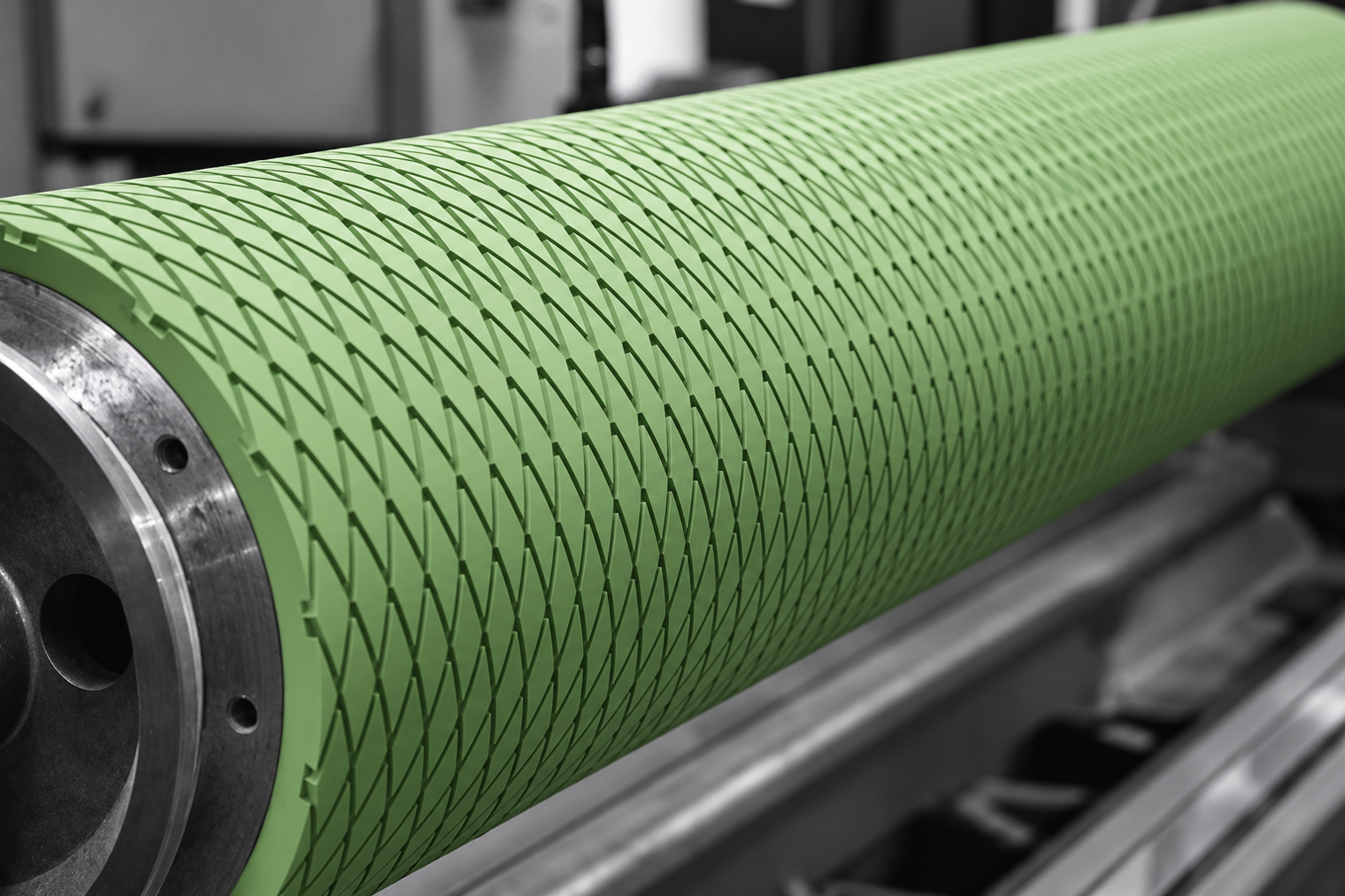
Industrial roller coverings: why the right surface makes all the difference
At first glance, an industrial roller may seem like a simple component. But did you know that its surface can have a major impact on production quality, efficiency and reliability?
The surface is where the roller meets the process. And even the smallest details can make a significant difference.
More than meets the eye
Whether guiding paper, transporting film, processing metal or handling textiles, every industrial roller has a specific function. Its surface must interact with the material being processed in exactly the right way.
Several characteristics play an essential role:
- Surface roughness: Influences grip, friction, material release and the quality of contact.
- Surface texture: Can improve traction, prevent slipping or facilitate material handling.
- Grooving and profiling: Help manage air, water and other liquids while optimising contact with the processed material.
- Surface uniformity: Ensures consistent contact conditions, contributing to stable production and product quality.
- Surface durability: helps maintain performance over time, even under demanding operating conditions
Smooth is not always better
A perfectly smooth surface might seem ideal, but that is not necessarily the case.
Some applications require a highly polished finish, while others benefit from a carefully engineered texture or groove pattern. Even microscopic differences in surface finish can influence how a roller performs.
The secret lies in finding the right surface characteristics for the right application.
Small details. Big impact.
At Hannecard, we understand that roller performance is not just about what lies beneath the surface, but also about what happens on it.
Through precision finishing, grinding, grooving and surface engineering, we help optimize roller performance for specific industrial processes.
Because sometimes, the smallest details on the surface make the biggest difference in production.